> ## Documentation Index
> Fetch the complete documentation index at: https://developers.hubspot.com/docs/llms.txt
> Use this file to discover all available pages before exploring further.

---
id: 9871375b-52bd-4034-84b8-93fd86ccdaeb
---

# Using modules in templates

> Reference information for using  modules in templates.

Modules can either be added directly to a template or added to individual pages with [drag and drop areas](/cms/start-building/building-blocks/drag-and-drop/overview) via the content editor. When a module is added to a template, the module will appear in that location by default. In contrast, modules added to drag and drop areas can be moved and removed, and other modules can be added around them.

After a module has been defined, you can get its field values at the template level through the [content.widgets dict](/cms/reference/modules/export-to-template-context#retrieving-parameters-from-modules-already-rendered-on-the-template).

## Basic module syntax

You can include a module in a template file using `{% %}` [statement delimiters](/cms/reference/hubl/overview), followed by specifying either `module` or `dnd_module`, depending on the implementation. `dnd_module` denotes a module within a [drag and drop area](/cms/start-building/building-blocks/drag-and-drop/overview#drag-and-drop-area-elements). Then, configure the module using a set of module detail fields, listed below. These fields can be formatted as individual lines or as a single block.

```jinja theme={null}
{% module
  "unique_module_name"
  path="@hubspot/module_type",
  parameterString='String parameter value',
  parameterBoolean=True
%}
```

| Parameter              | Type                                                       | Description                                                                                                                                                                                                                                                                                                                                                                                                                                                                                                                                                                                                                                                                                                                                                                                                                                                             |
| ---------------------- | ---------------------------------------------------------- | ----------------------------------------------------------------------------------------------------------------------------------------------------------------------------------------------------------------------------------------------------------------------------------------------------------------------------------------------------------------------------------------------------------------------------------------------------------------------------------------------------------------------------------------------------------------------------------------------------------------------------------------------------------------------------------------------------------------------------------------------------------------------------------------------------------------------------------------------------------------------- |
| `"unique_module_name"` | String                                                     | A custom name to identity the module, which should be unique within the context of the template. This name is used for populating the module with content added through the page editor. The name must be in quotes, and must be the second value defined within the module (after `module`/`dnd_module`).<br /><br /> If a page contains multiple modules with the same name, content added through the page/email editor will appear in both module instances.                                                                                                                                                                                                                                                                                                                                                                                                        |
| `path`                 | String                                                     | The path of the module, either the path [found in design manager](/cms/start-building/introduction/developer-environment/design-manager#default-modules-and-themes) or a relative path when developing locally. [HubSpot default module](/cms/reference/modules/default-modules) paths always start with `@hubspot/`.                                                                                                                                                                                                                                                                                                                                                                                                                                                                                                                                                   |
| Additional parameters  | String \| Boolean \| Integer \| Enumeration \| JSON object | Additional parameters to configure the module's behavior and how it renders. <ul><li>All modules have access to a set of [common module parameters](/cms/reference/modules/using-modules-in-templates#parameters-available-for-all-modules), such as `label`, along with parameters based on the [included module fields](/cms/reference/modules/using-modules-in-templates#field-based-parameters).</li><li>Parameter value syntax is based on the type of parameter. String values must be in single or double quotes (`"string"`/`'string'`) while boolean parameters do not require quotes (`True`/`False`).</li><li>Note that there is no in-editor validation for field values. For example, if module has a number field that has a minimum value of `1`, and you pass into the parameter a `0`, you will not see a warning that the value is invalid.</li></ul> |

Below are some additional examples of basic syntax for a default and custom module defined in a template.

```jinja theme={null}
{# HubSpot default text module #}
{% module "job_title"
  path="@hubspot/text",
  label="Job Title",
  value="Chief Morale Officer"
%}

{# Custom module #}
{% module "faqs"
  path="/myWebsite/modules/faq_module",
  label="Custom FAQ Module"
  faq_group_title="Commonly Asked Questions"
%}
```

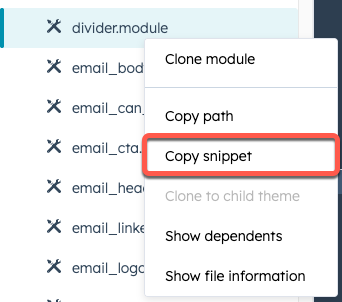
In the design manager, you can copy a module's basic HubL code by locating the module in the left sidebar, then right-clicking the module and selecting **Copy snippet**.

<Frame>
  <img src="https://developers.hubspot.com/hubfs/Knowledge_Base_2023-24-25/developer/design-manager-copy-module-snippet.png" alt="Screenshot of the copy snippet option in the design manager" />
</Frame>

## Passing dicts to module parameters

For modules with fields that expect dicts, you can pass them like you would other parameters. If it's cleaner to you or you plan to re-use the values, you can set the dict to a variable, and pass the variable to the parameter instead.

```jinja theme={null}
{% module "social_buttons",
  path="@hubspot/social_sharing",
  email={
    "default": true,
    "enabled": false,
    "img_src": "https://..."
  }
%}
```

### Passing fields that have dnd associated parameters

[Drag and drop tags](/cms/reference/hubl/tags/dnd-areas), such as `dnd_area`, come with a set of default parameters, such as `width`. While the design manager will prevent you from creating new fields that use one of these reserved parameters, modules created before drag and drop tags were introduced may already use a reserved parameter.

To fix this, you can use the `fields` parameter. Just like you would pass field data to a group, you can pass the field name as a key on the `fields` object. Its value must be consistent with the format the field type expects.

```jinja theme={null}
{% dnd_area "main_content" %}
  {% dnd_section %}
    {% dnd_column %}
      {% dnd_row %}
        {% dnd_module path="@hubspot/divider",
          fields={width: "90"}
        %}
        {% end_dnd_module %}
      {% end_dnd_row %}
    {% end_dnd_column %}
  {% end_dnd_section %}
{% end_dnd_area %}
```

## Setting default field values in templates

You can set default values for module fields at the template level by including parameters in the `dnd_module` tags. Below, learn how to set default field values in nested field groups, repeating fields, repeating field groups, and style fields.

### Nested field groups

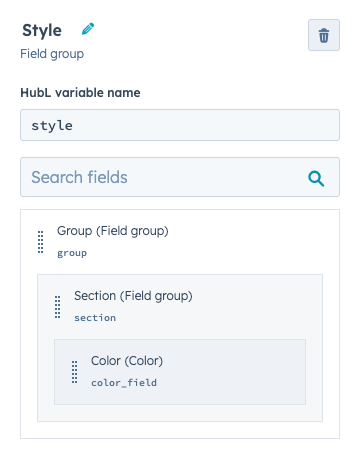
Below is an example of a custom drag and drop module with a custom `style` field group containing other nested field groups. Compare its template-level configuration with how this same grouping would appear in the design manager.

```jinja theme={null}
{% dnd_module
 path="/Nested_Module.module"
 style={
  "group":{
  "section":{
   "color_field":{
   "color" : "#000",
   "opacity" : 100
    }
   }
  }
 }
%}
{% end_dnd_module %}
```
<Frame>
  <img src="https://www.hubspot.com/hubfs/Knowledge_Base_2023/multi-level%20field%20nesting%20.png" alt="multi-level field nesting " />
</Frame>

### Repeating fields

You can set template-level default values for repeating fields by passing an array to the field's parameter. The array's items must be in the format expected based on the [field type](#field-based-parameters). For example:

* A simple text field only expects a string
* An image repeater field expects an image field object. This applies to [all of the other field types](#field-based-parameters).

```jinja theme={null}
{% module "recipe_card"
  path='../modules/recipe_card.module',
  ingredients=["Eggs","Ham","Cheese"]
%}

{% module "my_repeater_module"
path="/img_repeater_module",
label="img_repeater_module",
image=[
  {
    "src" : "https://www.hubspot.com/hubfs/WBZ%202025%20Rebrand/Hub%20Logos/Icons%20SVGs/marketing-hub-logo-small.svg",
    "alt" : "Marketing Hub Logo",
    "width" : 80,
    "height" : 80
  },{
    "src" : "https://www.hubspot.com/hubfs/WBZ%202025%20Rebrand/Hub%20Logos/Icons%20SVGs/sales-hub-logo-small.svg",
    "alt" : "Sales Hub Logo",
    "width" : 80,
    "height" : 80
  }
]
%}
```

### Repeating field groups

Modules that contain repeating groups of fields, like you might see in a slideshow module or FAQ module, can have a template-level default set for those groups. To do this, pass an array of objects to your field group's parameter. The key-value pairs of the object are the field names and their values.

```jinja theme={null}
{% module path='../modules/slideshow.module',
  slides=[
    {
    "caption":"Cute dog looking up",
    "image_url":"http://example.com/image.jpg",
    },
    {
    "caption":"Cuter cat not looking amused",
    "image_url":"http://example.com/image2.jpg",
    }
  ]
%}
```

### Style fields

you can explicitly set default values for [style fields](/cms/reference/fields/overview#style-fields) using the `styles` parameter.

This works just like other groups do, where the parameter is the name of the group. You pass an object to that parameter with all of the fields you wish to set.

```jinja theme={null}
{% dnd_module
    path="./path/to/module",
    styles={
      "background_color":{
          "color":"#123",
          "opacity":50
       }
    }
%}
```

## Block syntax

While most modules have parameters that control default content, there may be situations where you need to add large code blocks to the default content of a module. For example, you may want to include a large block of HTML as the default content for a rich text or HTML module. Rather than trying to write that code into a value parameter, insert the module using a `{% module_block %}` tag, then include within it a `{% module_attribute %}` tag that specifies content by the name of the field.

As an example, the following code would insert a custom `<p>` element into the `html` field of a default rich text module instance.

```jinja theme={null}
{% module_block module
  "my_rich_text_module"
  path="@hubspot/rich_text",
  label="rich_text.module"
%}
  {% module_attribute "html" %}
    <p>Hello there!</p>
  {% end_module_attribute %}
{% end_module_block %}
```

Older HubSpot templates may contain the deprecated `widget_block`, `widget_attribute`, and `type_of_module` parameters. These parameters have been replaced by `{% module_block %}`/`{% module_attribute %}`. Learn more by expanding the section below.

<Expandable title="legacy information">
  <br />

  Prior to the `module_block` syntax, `widget_block` was used. It follows the same pattern, except that it used opening tags of `widget_block`, and `widget_attribute`, and closing tags of `end_widget_attribute`, `end_widget_block`.

  <br />

  <br />

  The `widget_block` syntax is deprecated, but supported for backwards compatibility. It's still recommended to use `module_block` moving forward.

  <br />

  <br />

  The `type_of_module` parameter supports V1 HubSpot module names, for example: `rich_text` and `raw_html`. Additional parameters can be added to the first line of HubL. The second line defines which parameter the contents of the block will be applied to. For example, for a `rich_text` module this would be the `html` parameter. For a `raw_html` module, this would be the `value` parameter (examples below).

  <Tabs>
    <Tab title="HubL">
      ```jinja wrap theme={null}
      {# widget_block is deprecated, use module_block instead.
      This example is only to explain what type_of_module
       was used for, for those with legacy code. #}

      {% widget_block rich_text "my_rich_text_module" overrideable=True, label='My rich-text module'  %}
        {% widget_attribute "html" %}
          <h2>New Module</h2>
          <p>Add content here.</p>
        {% end_widget_attribute %}
      {% end_widget_block %}
      ```
    </Tab>

    <Tab title="Output">
      ```html theme={null}
      <span
        id="hs_cos_wrapper_my_rich_text_module"
        class="hs_cos_wrapper hs_cos_wrapper_widget hs_cos_wrapper_type_rich_text"
        style=""
        data-hs-cos-general-type="widget"
        data-hs-cos-type="rich_text"
      >
        <h2>New Module</h2>
        <p>Add content here.</p>
      </span>
      ```
    </Tab>
  </Tabs>
</Expandable>

## content\_attribute

In addition to regular and block syntax, there are certain instances where you may want to specify a large block default content for a predefined content variable. The most common example of this proves to be the [content.email\_body](/cms/reference/hubl/variables#email-variables) variable. This variable prints a standard email body that can be altered in the content editor. Since this isn't a standard HubL module, we use a **content\_attribute** tag to specify a block of default content. The example below shows the email body variable populated with a default content code block.

```jinja theme={null}
{% content_attribute "email_body" %}
  <p>Hi {{ contact.firstname }},</p>
  <p>Describe what you have to offer the customer. Why should they read? What did you promise them in the subject line? Tell them something cool. Make them laugh. Make them cry. Well, maybe don't do that...</p>
  <p>Use a list to:</p>
  <ul>
    <li>Explain the value of your offer</li>
    <li>Remind the reader what they’ll get out of taking action</li>
    <li>Show off your skill with bullet points</li>
    <li>Make your content easy to scan</li>
  </ul>
  <p><a href="http://hubspot.com">LINK TO A LANDING PAGE ON YOUR SITE</a> (This is the really important part.)</p>
  <p>Now wrap it all up with a pithy little reminder of how much you love them.</p>
  <p>Aw. You silver-tongued devil, you.</p>
  <p>Sincerely,</p>
  <p>Your name</p>
{% end_content_attribute %}
```

## Parameters available for all modules

While some modules have certain [special parameters](/cms/reference/hubl/tags/standard-tags), below is a list of parameters supported by all modules.

| Parameter                    | Type    | Description                                                                                                                                                                                                                                                                                                                                                                                                                                         | Default |
| ---------------------------- | ------- | --------------------------------------------------------------------------------------------------------------------------------------------------------------------------------------------------------------------------------------------------------------------------------------------------------------------------------------------------------------------------------------------------------------------------------------------------- | ------- |
| `label`                      | String  | The name of the module displayed in the content editor. This parameter can also be used to give users additional instructions.                                                                                                                                                                                                                                                                                                                      |         |
| `overrideable`               | Boolean | Controls whether or not the module can be edited in the content editor, equivalent to the *Prevent editing in content editors* setting in the design manager.                                                                                                                                                                                                                                                                                       | `True`  |
| `no_wrapper`                 | Boolean | When set to `True`, removes the wrapping markup from around the content of a module.On pages, modules are always wrapped in a `<div>` with special classes. This wrapping markup makes it so when you click the module in the preview pane, the editor scrolls to that module. There may be instances where you want to remove the wrapper, such as if you want to use a text module to populate the destination of an anchor tag `href` attribute. | `False` |
| `extra_classes`              | String  | Adds classes to the module wrapper. You can add multiple classes by separating the classes with spaces. For example:`extra_classes='full-width panel'`                                                                                                                                                                                                                                                                                              |         |
| `export_to_template_context` | Boolean | When set to `True`, instead of rendering the HTML, the parameters from this widget will be available in the template context. [Learn how to use this parameter and the widget\_data tag.](/cms/reference/modules/export-to-template-context)                                                                                                                                                                                                        | `False` |
| `unique_in_loop`             | Boolean | When the module is defined within a loop, appends the module name with the loop.index. When set to `True`, a different version of the module will print within each iteration of the loop. Appends the module name with the loop.index.                                                                                                                                                                                                             | `False` |

## Field-based parameters

When defining a module in a template file, you can pass additional parameters to the module based on the module's defined fields. For HubSpot default modules, you can find available parameters in the [default web modules reference](/cms/reference/modules/default-modules). When working with modules locally, you can find a module's fields in the `fields.json` file.

The format for the parameter value depends on the field's `type`. For example, the [default button module](/cms/reference/modules/default-modules#button) includes a [`link` field](/cms/reference/fields/module-theme-fields#link), which accepts a JSON object. In the template, you could pass those URL details as shown below.

```jinja theme={null}
{% module "button"
path="@hubspot/button",
button_text="Go Home"
link={
  "url":{
    "type": "EXTERNAL",
    "href": "/"
  },
    "open_in_new_tab": false,
    "no_follow": false
  }
%}
```

The field's name determines how you specify it in the parameter override, so if the field were named `link_field` instead of `link`, your module code would need to include a `link_field` parameter instead.

```jinja highlight={4} theme={null}
{% module "custom_button"
path="/custom-button",
button_text="Click if you dare"
link_field={
  "url":{
    "type": "EXTERNAL",
    "href": "/"
  },
    "open_in_new_tab": false,
    "no_follow": false
  }
%}
```

Below, learn more about the available types of fields and the values they accept. For more information about field configuration, check out the [module and field types reference](/cms/reference/fields/module-theme-fields).

| Field               | Type                            | Example                                                |
| ------------------- | ------------------------------- | ------------------------------------------------------ |
| Blog                | Integer (blog ID)               | `1234567890`                                           |
| Boolean             | True/False                      | `False`                                                |
| Choice              | String                          | `"option_1"`                                           |
| Color               | Object                          | See [color parameters](#color-parameters)              |
| CTA                 | String (CTA ID)                 | `"fb9c0055-6beb-489d-8dda-3e1222458750"`               |
| Date                | Integer (timestamp)             | `1566360000000`                                        |
| Datetime            | Integer (timestamp)             | `1566360000000`                                        |
| Email address       | Array of email address strings  | `["develop@hubspot.com", "design@hubspot.com"]`        |
| File                | String (URL of file)            | `"https://cdn2.hubspot.net/hubfs/file.pdf"`            |
| Follow Up Email     | Integer (follow up email ID)    | `1234567890`                                           |
| Font                | Object                          | See [font parameters](#font-parameters)                |
| Form                | Object                          | See [form parameters](#form-parameters)                |
| HubDB Table         | Integer (HubDB table ID)        | `123456789`                                            |
| Icon                | Object                          | See [icon parameters](#icon-parameters)                |
| Image               | Object                          | See [image parameters](#image-parameters)              |
| Link                | Object                          | See [link parameters](#link-parameters)                |
| Logo                | Object                          | See [logo parameters](#logo-parameters)                |
| Meeting             | String (meeting link)           | `"https://app.hubspot.com/meetings/developers-r-kewl"` |
| Menu                | Integer (menu ID)               | `123456789`                                            |
| Number              | Integer                         | `1`                                                    |
| Page                | Integer (page ID)               | `1234567890`                                           |
| richtext            | String (can contain HTML)       | `"# Hello, world!"`                                    |
| Salesforce Campaign | String (Salesforce campaign ID) | `"7016A0000005S0tQAE"`                                 |
| Simple Menu         | Array of menu item objects      | See [simple menu parameters](#logo-parameters)         |
| Tag                 | Integer (tag ID)                | `1234567890`                                           |
| Text                | String                          | `"string it together"`                                 |
| URL                 | Object                          | See [URL parameters](#url-parameters)                  |

### Color parameters

Pass a color field parameter as a JSON object containing a hexadecimal color code and numerical opacity value.

```jinja theme={null}
{% module "my_module"
  path="../modules/my_custom_module",
  color={
    "color": "#ff0000",
    "opacity": 85
  }
%}
```

### Font parameters

Pass a font field parameter as a JSON object containing font configuration details.

```jinja theme={null}
{% module "my_module"
  path="../modules/my_custom_module",
  font={
    "size": 12,
    "size_unit": "px",
    "color": "#000",
    "styles": {
      "text-decoration": "underline"
    },
    "font": "Roboto",
    "fallback": "serif",
    "variant": "regular",
    "font_set": "GOOGLE"
  }
%}
```

### Form parameters

Pass a form field parameter as a JSON object containing form configuration details

```jinja theme={null}
{% module "my_module"
  path="../modules/my_custom_module",
  form={
    "form_id": "9aa2e5f3-a46d-4774-897e-0bc37478521c",
    "response_type": "redirect",
    "redirect_url": "http://www.hubspot.com",
    "redirect_id": null
  }
%}
```

| Parameter       | Type   | Description                                                                                                                                                       |
| --------------- | ------ | ----------------------------------------------------------------------------------------------------------------------------------------------------------------- |
| `form_id`       | String | The form's ID. Learn how to [find a form ID in HubSpot](https://knowledge.hubspot.com/forms/find-your-form-guid).                                                 |
| `response_type` | String | The behavior after form submission. Can be one of: <ul><li>`inline`: an inline text message.</li><li>`redirect`: redirect the visitor after submission.</li></ul> |
| `redirect_url`  | String | The redirect URL (if redirecting)                                                                                                                                 |
| `redirect_id`   | String | The ID of a HubSpot page to redirect to (if redirecting)                                                                                                          |
| `message`       | String | The message to display after submission (if displaying an inline text message).                                                                                   |

### Icon parameters

Pass an icon field parameter as a JSON object containing FontAwesome icon configuration details.

```jinja theme={null}
{% module "my_module"
  path="../modules/my_custom_module",
  icon={
  "name": "apple",
  "unicode": "f179",
  "type": "SOLID"
  }
%}
```

| Parameter     | Type   | Description                                                                     |
| ------------- | ------ | ------------------------------------------------------------------------------- |
| `name`        | String | The icon's name.                                                                |
| `unicode`     | String | The icon's unicode value.                                                       |
| `type`        | String | The type of icon. Can be one of: `"SOLID"`, `"REGULAR"`                         |
| `redirect_id` | String | The ID of a HubSpot page to redirect to (if redirecting)                        |
| `message`     | String | The message to display after submission (if displaying an inline text message). |

### Image parameters

Pass an image field parameter as a JSON object containing image configuration details.

```jinja theme={null}
{% module "my_module"
  path="../modules/my_custom_module",
  image={
    "src": "https://cdn2.hubspot.net/hubfs/image.jpeg",
    "alt": "an_image",
    "width": 100,
    "height": 100
  }
%}
```

### Link parameters

Pass a link field parameter as a JSON object containing link configuration details. Learn more about url types in the [link field reference](/cms/reference/fields/module-theme-fields#link).

```jinja theme={null}
{% module "my_module"
  path="../modules/my_custom_module",
  link={
    "url":{
      "type": "EXTERNAL",
      "href": "/"
    },
      "open_in_new_tab": false,
      "no_follow": false
    }
%}
```

### Logo parameters

Pass a logo field parameter as a JSON object containing logo configuration details.

```jinja theme={null}
{% module "my_module"
  path="../modules/my_custom_module",
  logo={
    "override_inherited_src": true,
    "src": "https://cdn2.hubspot.net/hubfs/logo.png",
    "alt": "best_logo_ever",
    "width": 100,
    "height": 100
  }
%}
```

### Simple menu parameters

Pass a simple menu parameter as an array containing JSON objects of menu configuration details. You can link either to pages that are hosted in the HubSpot account, or external pages by URL.

```jinja theme={null}
{% module "my_module"
  path="../modules/my_custom_module",
  simplemenu=[
    {
    "isPublished": true,
    "pageLinkId": 123456789,
    "pageLinkName": "Page 1",
    "isDeleted": false,
    "categoryId": 1,
    "subCategory": "site_page",
    "contentType": "site_page",
    "state": "PUBLISHED_OR_SCHEDULED",
    "linkLabel": "Page 1",
    "linkUrl": null,
    "linkParams": null,
    "linkTarget": null,
    "type": "PAGE_LINK",
    "children": []
  },
  {
    "linkLabel": "Page 2",
    "linkUrl": "https://www.google.com",
    "linkTarget": "_blank",
    "type": "URL_LINK",
    "children": [
    	{
        "linkLabel": "Child 1",
        "linkUrl": "https://www.google.com",
        "linkTarget": "_blank",
        "type": "URL_LINK",
        "children": [],
      }
    ],
  }
]
%}
```

| Parameter      | Type    | Description                                                                                                                                                                                    |
| -------------- | ------- | ---------------------------------------------------------------------------------------------------------------------------------------------------------------------------------------------- |
| `isPublished`  | Boolean | Whether the page is published (for HubSpot-hosted pages).                                                                                                                                      |
| `pageLinkId`   | Integer | The page ID (for HubSpot-hosted pages).                                                                                                                                                        |
| `pageLinkName` | Boolean | The page's name (for HubSpot-hosted pages).                                                                                                                                                    |
| `isDeleted`    | Boolean | Whether the page has been deleted (for HubSpot-hosted pages).                                                                                                                                  |
| `categoryId`   | Integer | The ID of the page category. Can be one of: <ul><li>`1`: Website page</li><li>`3`: Blog post</li><li>`12`: Knowledge base article</li><li>`4`</li></ul>                                        |
| `subCategory`  | String  | The page subcategory. Can be one of: `site_page`, `landing_page`, `blog`, `normal_blog_post`.                                                                                                  |
| `contentType`  | Integer | The page's content type. Can be one of: `site_page`,`landing_page`,`blog`                                                                                                                      |
| `state`        | String  | The publish state of the page. Can be one of: <ul><li>`DRAFT`</li><li>`DRAFT_AB`</li><li>`PUBLISHED`</li><li>`PUBLISHED_OR_SCHEDULED`</li><li>`PUBLISHED_AB`</li><li>`SCHEDULED`</li></ul>     |
| `linkLabel`    | String  | The text that will be displayed for the menu item.                                                                                                                                             |
| `linkUrl`      | String  | The URL of the menu item.                                                                                                                                                                      |
| `linkParams`   | String  | Query parameters appended to the link URL (for menu items of the `PAGE_LINK_WITH_PARAMS` type).                                                                                                |
| `linkTarget`   | String  | Set to `"_blank"` to open the link in a new browser tab.                                                                                                                                       |
| `type`         | String  | The type of menu item. Can be one of: <ul><li>`"PAGE_LINK"` (HubSpot page)</li><li>`"PAGE_LINK_WITH_PARAMS"` (HubSpot page)</li><li>`"NO_LINK"`</li><li>`"URL_LINK"` (external page)</li></ul> |
| `children`     | Array   | An array of sub-menu items.                                                                                                                                                                    |

### URL parameters

Pass a URL field parameter as a JSON object containing logo configuration details. Similar to link field parameters, but with fewer customization options.

```jinja theme={null}
{% module "my_module"
  path="../modules/my_custom_module",
  link={
    "type" : "CONTENT",
    "href" : null,
    "content_id" : 123456789
  }
%}
```

| Parameter    | Type   | Description                                                                                                                                                                                                                                                                                           |
| ------------ | ------ | ----------------------------------------------------------------------------------------------------------------------------------------------------------------------------------------------------------------------------------------------------------------------------------------------------- |
| `type`       | String | The type of link. Can be one of:<ul><li>`"EXTERNAL"`: for external links</li><li>`"CONTENT"`: for website pages, landing pages, and blog posts</li><li>`"FILE"`: for files hosted in the file manager</li><li>`"EMAIL_ADDRESS"`: for email addresses</li><li>`"BLOG"`: for blog index pages</li></ul> |
| `href`       | String | The URL of the link.                                                                                                                                                                                                                                                                                  |
| `content_id` | String | The ID of the page you're linking to (for HubSpot-hosted pages).                                                                                                                                                                                                                                      |
